
How Jeff Galloway Inspires Runners at 79:
Over two hundred and thirty marathons have been run by Jeff Galloway. He has been a running coach for more than 50 years, competed for the United States in the 1972 Munich Olympics, and has a personal best time of about 28 minutes in the 10,000 meters. However, this 79-year-old's invention of the run-walk technique known as "Jeffing," which both novice and expert runners may use, may be his greatest accomplishment.

“First of all, I have to say how proud I am to be a verb,” Jeff Galloway begins, before revealing that the concept was first proposed in 1973. Beginners were having a variety of aches and pains when I encouraged them to run. It dawned on me then that even elite athletes need to properly warm up. They jog at a modest intensity at first, then pick up the pace to enhance blood flow.
I then used the pace-shifting template on a sample of 22 individuals, whose average age was 42. First we walked, then we jogged, and then we walked once again. at following that pattern, all 22 participants had finished a 5K or a 10K race at the end of the 10-week program. That was astonishing in and of itself, but the fact that nobody was hurt was even more noteworthy. I have never before trained a group of runners without at least one injury.
According to Jeff Galloway, he hasn’t been hurt since 1978. He feels that his walk-run approach is more “natural” than running nonstop. Anthropologists claim that although humans were meant to go great distances—up to 5,000 miles during early migrations—we were not meant to run continuously. One of the reasons so many people break down is that continuous running isn’t ingrained in our DNA.
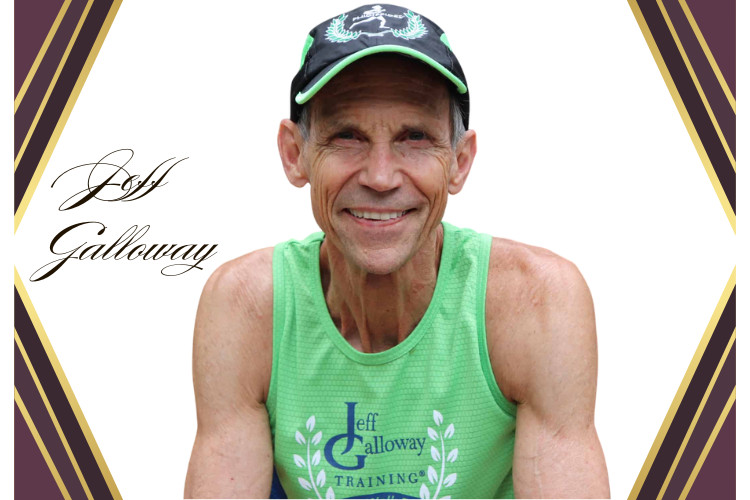
People can exercise regularly and reap the mental and physical rewards since Jeffing lowers the chance of injury. These advantages are referred to by Jeff Galloway as “circuits.”
“The ‘good attitude’ circuit makes your stress disappear,” he says. The “vitality” circuit comes next. You may start a workout feeling exhausted, but once you get rolling, you’ll feel energetic for the remainder of the day. Our ancestors were able to continue moving while looking for food thanks to that input. The “empowerment” circuit comes last. Go Jeffing, and you’ll frequently discover answers to your issues.
Walking and running are considered aerobic workouts from a physical perspective. They promote weight management, strengthen cardiovascular health, and increase blood and oxygen flow. He confidently points out that the routine helps shed body fat, adding with a smile, “Just take a look at me.” At 79, I still weigh the same as I did during the 1972 Olympics.
He highlights that these advantages result from reducing physical stress.
Sandra Haynes, a 57-year-old Liskeard, Cornwall resident who began running in 2016, may relate to this. She claims that it has significantly increased her level of fitness. In addition to helping with menopause symptoms, it has improved my mental health. All things considered, it’s a sustainable approach to maintain your fitness while conversing and joking with others who share your interests. I hope that, as our organization intends, I will still be doing this in my seventies.
In 2021, Haynes founded Power Runs Cornwall. She first provided a Couch to 5K-like course called Run-30, which was intended to assist participants run nonstop for 30 minutes by the program’s conclusion. Although the ensemble performed well, she saw that a lot of people were being hurt.

“That’s when we offered Jeffing as an option. It really took off. In fact, we now have more Jeffers than nonstop runners. If Jeffing hadn’t been available, many people would have quit exercising altogether.”
She says that 15 to 25 people of various ages and genders attend the twice-weekly Jeffing sessions. They split into two groups, offering either 3K or 5K distances. There’s a leader at the front and a tail-ender at the back, and they adjust the walk-run strategy depending on the terrain and how everyone feels.
If you’re trying Jeffing yourself, Jeff Galloway suggests using your breathing as a guide. “When you start to breathe heavily and laboriously, stop running and take a quick walking break instead. In many cases, that’s more accurate than using a heart monitor.”
At first, this might mean one- or two-minute running intervals followed by longer walking intervals, for about 20 minutes total. Over time, the running intervals become longer and the walking breaks shorter. The overall session length can also increase depending on your goals. For some, it’s simply Jeffing with a friend. For others, it’s preparing for a race.
” I use the Jeffing method in every race I enter, and I’m aiming to complete a 10-mile race in 2025,” adds Haynes. I’ve met many Jeffers who have completed Jeffed marathons, half-marathons, 5Ks, and 10Ks. The Girls That Jeff Facebook page is a huge supporter of Jeffing. I recently met an experienced runner who was heading to the Boston Marathon using Jeff’s method.”
Surprisingly, Jeffing doesn’t necessarily mean slowing down. Jeff Galloway says that when veteran runners saw beginner Jeffers finishing marathons faster than them, they started asking questions.
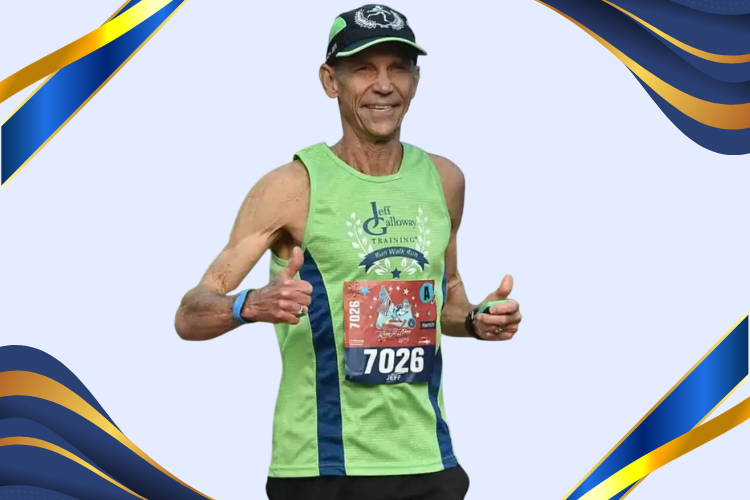
A 2016 study published in the Journal of Science and Medicine in Sport supports this idea. It found that non-elite Jeffing participants reached the marathon finish line in nearly the same time as nonstop runners. A mixed-gender group of run-walkers finished between 4:14 and 4:34, while the nonstop runners finished between 4:07 and 4:34.
Jeff Galloway explains that according to his collected data, a 30-second walking break delivers the greatest overall advantage during training. ““It keeps your speed steady while reducing muscle exhaustion right from the beginning.” Take a 26-mile marathon. When you reach the halfway mark, your legs don’t feel like they’ve run 13 miles—they feel more like 10 or 11. In many races, our Jeffers are the ones passing people at the end. And there’s nothing more thrilling than that!”
That’s why about 40% of the people who sign up for his training programs are experienced runners—either aiming to improve their speed or hoping to keep running well into their 100s.
If you’re an experienced runner, you might wonder how Jeffing differs from fartlek training, which alternates between sprinting and jogging. Jeff Galloway says, “They’re similar, but you don’t pre-decide when and how long you’ll sprint in a fartlek.”
And in Jeffing, you don’t actually sprint. You begin with a set walk-run ratio, though you can adjust it during the session depending on how strong or tired you feel. It’s individual.”
Jeff Galloway is 100% a Jeffer and has been for years. He believes it has kept him fit and may even have saved his life.
“I had a heart attack three years ago due to exposure to Agent Orange during the Vietnam War.” The U.S. used the chemical herbicide to clear jungle foliage and expose hidden Viet Cong forces. “It caused a blockage in my right artery. Blood wasn’t flowing, but I survived because of collateral circulation—backup blood vessels that take over when an artery is blocked.
My doctor said if I had been trying to run nonstop all those years, this would have happened 20 years earlier and I would have died. Thankfully, I’m addicted to Jeffing. Addiction to other things is worse.