
David Byrne Early Life and Background:
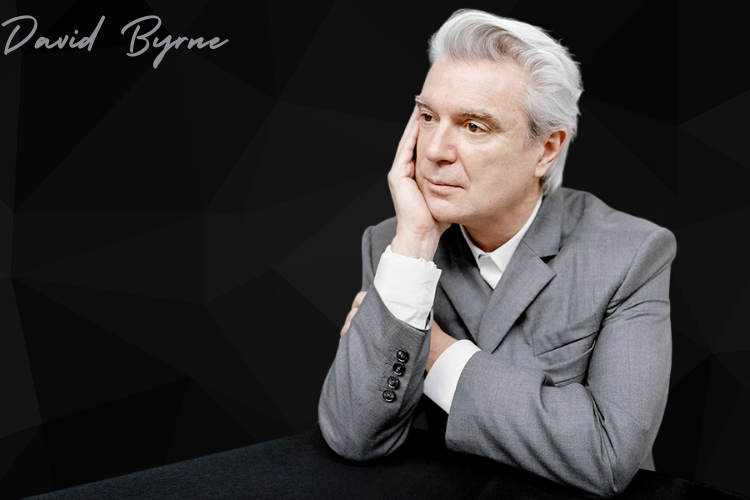
David Byrne is a Scottish musician and multidisciplinary artist who was born in Dumbarton, Dunbartonshire, Scotland, on May 14, 1952. He is most recognized for being the frontman of the significant American art-rock group Talking Heads. Later on, he became well-known for his varied and imaginative solo career.
Formation of Talking Heads:
David Byrne’s Scottish parents relocated to Canada and then the US when he was a young boy. He was the lead singer and guitarist of Talking Heads, a band he co-founded in the middle of the 1970s while attending the Rhode Island School of Design. Associated with the punk and new wave movements, the band released its debut album Talking Heads: 77 in 1977. Byrne’s interest in experimental pop and African rhythms was evident in a number of subsequent albums, such as Remain in Light (1980), Speaking in Tongues (1983), and the concert-film soundtrack Stop Making Sense (1984). The group broke up in 1988 following the release of the album Naked.
Creative Projects Beyond the Band:
David Byrne continues to focus on other artistic endeavors even during the height of Talking Heads’ fame. He worked with Brian Eno on the innovative album My Life in the Bush of Ghosts (1981), which combined rhythmic patterns with sampled vocals, and wrote music for choreographer Twyla Tharp’s performance The Catherine Wheel (1981) during a hiatus from the band in the early 1980s. In addition, Byrne won an Academy Award for his work on the soundtrack of The Last Emperor (1987) and wrote and directed the unusual movie True Stories (1986). He also wrote music for two Robert Wilson-directed theatrical performances in the 1980s.
Solo Career and Record Label:
David Byrne established Luaka Bop Records in 1988 with the intention of exposing American listeners to a range of foreign music genres. His solo music career truly began with Rei Momo (1989), which showcased strong African and Latin influences. Feelings (1997), Grown Backwards (2004), and Uh-Oh (1992) are some of his other solo albums. Later, he worked with singer-songwriter St. Vincent on Love This Giant (2012) and reunited with Brian Eno for the gospel-inspired album Everything That Happens Will Happen Today (2008).

Work in Film, Theater, and Art:
David Byrne continued to work in theater and movies in the twenty-first century. Notably, he collaborated with electronic DJ Fatboy Slim to create Here Lies Love, a disco musical based on the life of Filipino political figure Imelda Marcos. The project’s first stage show debuted in 2013 after the songs were recorded and published as an album in 2010. Throughout his career, David Byrne has also authored a number of books, such as How Music Works (2012) and Bicycle Diaries (2009), had exhibitions, and produced visual art.
American Utopia and Recent Work:
In 2018, he started a website and lecture series called Reasons to Be Cheerful, which was inspired by an Ian Dury song. In it, he emphasized the good things that have happened recently. He collaborated with Eno once more on the publication of American Utopia that same year. Later, the album served as inspiration for David Byrne’s Broadway production of American Utopia (2019–), which featured Talking Heads songs. In 2020, Spike Lee’s cinematic adaption debuted on HBO.

Talking Heads Band Overview and Evolution of the Band:
The American art rock group Talking Heads rose to fame in the late 1970s and early 1980s. Singer-guitarist David Byrne was born in Dumbarton, Scotland, on May 14, 1952; drummer Chris Frantz was born in Fort Campbell, Kentucky, on May 8, 1951; bassist Tina Weymouth was born in Coronado, California, on November 22, 1950; and keyboardist Jerry Harrison was born in Milwaukee, Wisconsin, on February 21, 1949.
Three Rhode Island School of Design students founded the band Talking Heads after relocating to New York City in 1974. David Byrne, Frantz, and Weymouth broadened their sound by integrating dance rhythms after challenging conventional rock music with humorous aspects influenced by contemporary literature and art. Over the course of the following ten years, the band changed from a simple, intimate sound to a rich, multicultural sound and back again after Harrison, a former member of the Modern Lovers, joined in 1976. Their films and videos were also very influential, and their fame helped open doors for other experimental rock musicians.
Musical Style and Impact:
On Talking Heads: 77, which included the song “Psycho Killer, “David Byrne’s eerie lyrics, eccentric demeanor, and piercing vocal delivery stood out. The record sold remarkably well even though it was very different from popular trends. The band’s music offered a unique and contemplative alternative to the popular genres of arena rock, disco, and punk by fusing danceable rhythms with intellectual depth. As their music evolved, fans interested in funk and world music found it particularly enticing, especially urban, culturally curious audiences.
Collaboration with Brian Eno:
The band’s choice to collaborate with Brian Eno as a producer reinforced their dedication to developing as artists. In their 1978 album More Songs About Buildings and Food, Eno added drums and other sounds after starting with a minimalist approach. It’s interesting to note that their hit rendition of Al Green’s “Take Me to the River” was a major factor in the album’s financial success.
Eno’s creative approaches—combining songwriting, performance, and production—helped raise the band’s goals throughout the course of three albums. Notable songs from this era include “I Zimbra” and “Life During Wartime” (from Fear of Music, 1979) and “Once in a Lifetime” and “The Great Curve” (from Remain in Light, 1980), which was Eno’s last album with the group.
Later Years and Breakup:
The band made a comeback with Speaking in Tongues (1983), which featured the top ten hit “Burning Down the House,” following a year of solo endeavors (during which Frantz and Weymouth, who were married in 1977, formed the dance-oriented group Tom Tom Club) and the release of a live album (The Name of This Band Is Talking Heads, 1982). The music to Jonathan Demme’s critically acclaimed concert film, Stop Making Sense (1984), came next. The band’s first million-selling album, Little Creatures (1985), marked a return to a more straightforward musical approach. Following the release of their last album, Naked, in 1988, the band quietly broke up without making a public announcement.
Legacy and Aftermath:
Following the split, David Byrne had an intriguing and varied solo career. Frantz and Weymouth collaborated as a producing team, and Harrison went on to become a producer. Harrison, Weymouth, and Frantz got back together in 1996 for a tour and album under the moniker The Heads, despite Byrne’s unsuccessful legal challenge. In 2002, Talking Heads was admitted into the Rock and Roll Hall of Fame.