
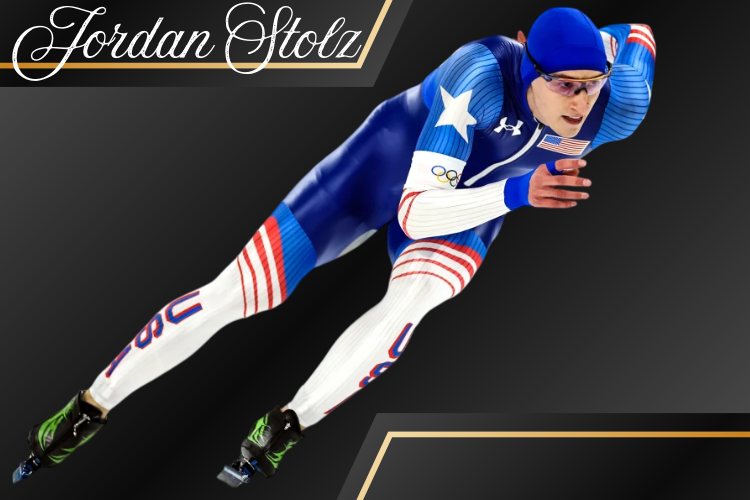
Jordan Stolz’s Olympic Records and Gold Medals:
With one and a half laps around the oval, no pacing, no recuperation window, and little space for technical compromise, men's 500-meter speed skating is the most brutal version of the sport. Jordan Stolz advanced his Olympic campaign to record heights on Saturday afternoon in the western suburbs of Milan by mastering the fastest and most unpredictable event in speed skating.In what is fast becoming one of the most memorable individual performances of these Winter Games, the 21-year-old American won the 500m in an Olympic record time of 33.77 seconds, earning his second gold medal at the Milano Cortina 2026 Winter Olympics.
Additionally, Jordan Stolz has two races, two gold medals, and two Olympic records to start these Games. The entire podium finished below the previous Olympic record of 34.32 seconds in a final that changed the course of history. Stolz took the lead in 33.77 seconds, followed by Laurent Dubreuil of Canada in 34.26 and Jenning de Boo of the Netherlands in 33.88.
On some ways, the performance was historic. At sea level, Stolz’s time is the quickest 500 meters ever skated. His victory margin of 0.11 seconds was the biggest in a single Olympic 500-meter event since 1988.

Jordan Stolz didn’t triumph by controlling the game from beginning to end. Rather, he possessed the three characteristics that usually distinguish Olympic champions from podium competitors at this distance: a strong start, almost flawless first-corner technique, and amazing speed maintenance down the back straight. Such phase-to-phase balance is uncommon in contemporary sprint skating, where ice friction and aerodynamic drag penalize even the smallest error.
The result is noteworthy not only because it added another medal but also because of the nature of the distance itself. The 500m is typically thought to be the most challenging of Stolz’s three main solo events. The opening push demands maximum speed, races are often decided by a hundredth of a second, and even the strongest skaters may lose control before they leave the first corner.
In the third-to-last of fifteen heats, Jordan Stolz faced off against de Boo, the skater who ended Stolz’s two-year tenure as world champion in this distance last March in Hamar, Norway. This was one of the most anticipated games of the afternoon. If his tremendous closing pace was the defining factor in his victory in the 1000m on Wednesday, the 500m required instant accuracy. This is exactly what Jordan Stolz did.
It was quite close. Before the race, I knew it would be close, Stolz remarked. ” If I skated a perfect race and made a good last outer turn, I thought I might win.
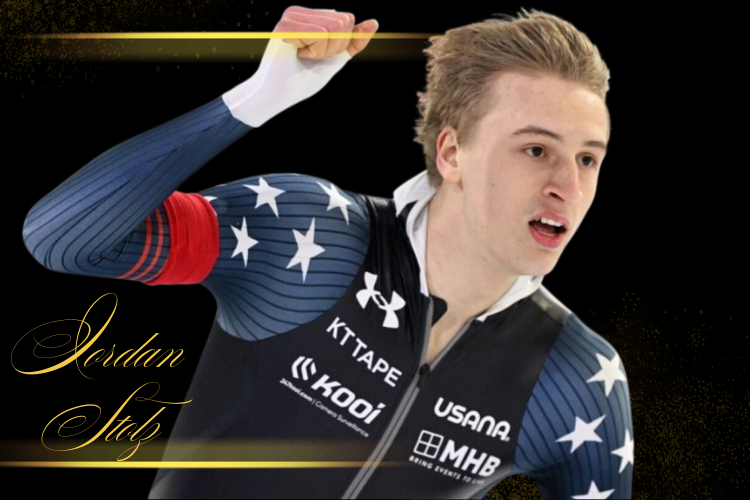
He exploded out of the start and carried his characteristic low and powerful body posture into the first turn, maintaining speed down the back straight with technical stability in line with his growth as a skater.Coming down the final hundred meters, I thought I could beat him, and I did,” he said. ” felt his approach and confidently moved forward. When I first came around the corner, I was hoping to hear his skates, but I couldn’t. When he finally started to follow me, I knew, “I can now defeat him.”
Earlier in the week, he laid the groundwork for this victory by winning the gold medal in the 1000m by the largest Olympic margin since 1984, which immediately made him the center of attention for the long-track story at these Games.
jordan Stolz claimed that the emotional boost from the prior success caused him to approach Saturday differently. “There was much less pressure,” he said. I was aware of the atmosphere and what to anticipate once I truly wanted to win the 1000 meters.

” I stayed pretty calm for most of the day, but the nerves finally hit me roughly thirty minutes before the event began. I became quite concentrated after that. I was just thinking about the push, visualizing the entire race and my desired course of action. I’m glad I was successful.
After two races in the program, it’s hard to ignore the larger historical context. Eric Heiden’s five gold medals in the 1980 Winter Olympics in Lake Placid broke a men’s record for the most speed skating gold medals at an Olympic Games, making it one of the greatest Olympic achievements ever.
When Jordan Stolz arrived in Milan, he was a multi-event gold candidate. Since two wins have already been guaranteed, the possibilities are still present. He also joins Heiden, who was present on Saturday, as the only other man in history to complete the Olympic 500-meter-1000-meter double.
Since making his Olympic debut in Beijing in 2022 at the age of 17, he has risen quickly. He placed 13th in the 500m and 14th in the 1000m back then. Four years later, he is setting the tone for competition in the Olympic long-track program.
Jordan Stolz, who was up in Kewaskum, Wisconsin, and received his education at the Pettit National Ice Center in Milwaukee, sees speed skating more as an art form than a technique. He focuses on what he calls “free speed,” which includes understanding ice density, maximizing aerodynamic efficiency, and fine-tuning blade configuration. The Milan track, a makeshift Olympic venue that has already produced some of the fastest speeds in Olympic history, has been a perfect fit for that mindset.
As the Olympic schedule moves to Thursday’s 1500m, Stolz might become just the second American to win three gold medals in a single Winter Olympics. Furthermore, the mass start event has not yet taken place. In 1994, Norwegian speed skater Johann Olav Koss became the only person to win three gold medals at a single Winter Games, setting another historic record that can currently be achieved.
Jordan Stolz has ruled out the chance that his effort will be hampered by the 500m. With two gold medals already won and records falling all around him, the possibility of a really historic Olympic performance is growing in real time.