
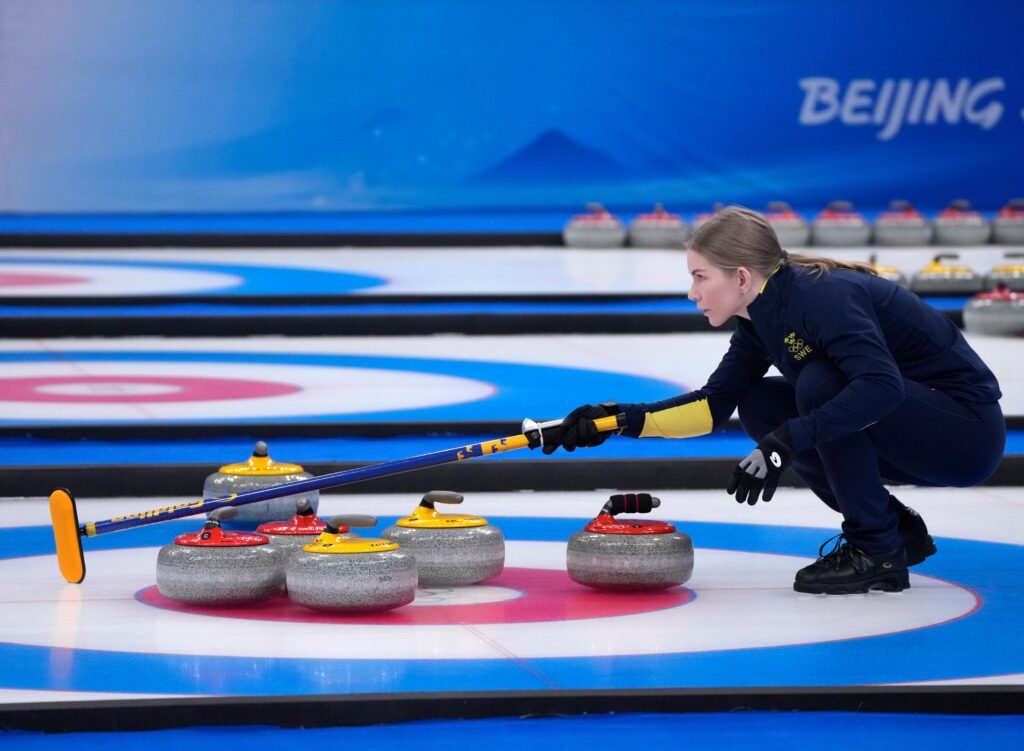
Curling Stones, Ice, and Rink Dimensions:
Although measurements can vary slightly, a curling rink is roughly 42.1 meters (138 feet) long and 4.2 meters (14 feet) wide. The diameter of each building is 3.6 meters (12 feet), and the distance between their centers is 34.7 meters (114 feet). A stone must land between the back line behind the house and the hog line, which is 6.4 meters or 21 feet before the tee, in order for it to be scored. Behind the back line is the hack, which is a rubber block that players push off when delivering the stone.
The average weight of a stone is 18.1 kg (40 pounds), and it can’t be more than 19.9 kg (44 pounds). It must be at least 11.4 cm (4.5 inches) tall, with a maximum circumference of 91.4 cm (36 inches). Ailsa Craig, a secluded island off the southwest coast of Scotland, is home to a unique, solid granite that is used to make nearly all stones.
Curling is a game played on ice that is comparable to lawn bowls. A game competition is played between two teams of four players each, referred to as the lead, second, third, and skip. In order to reach the tee, or button, each player slides around stones on the ice of an ice rink or a natural ice field. This button is a fixed mark located in the middle of the “house,” a circular target area that is surrounded by concentric rings. The stones have a handle on top and are somewhat hollowed underneath.
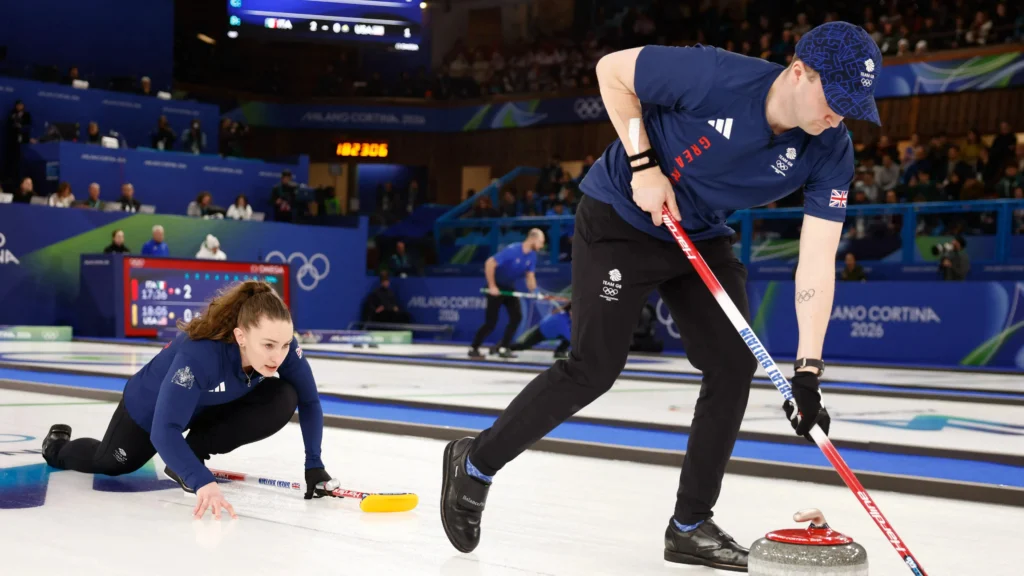
The game’s objective is straightforward: each team aims to position its stones as near the center as they can. Early in the 16th century, emerged in northern Europe, and by the late 19th century, it had developed into a recognized competitive sport. Beginning with the 1998 Games, it was incorporated into the Winter Olympic program for good.
Every turn, each player tosses two stones. One team’s lead starts the order, while the skip, who doubles as the team leader, finishes it. Each stone that rests closer to the tee than any other stone from the other team earns points. Unless no stones land in the house or the closest stones from both teams are precisely the same distance from the center, no points are given. However, a team can score up to eight points from the 16 stones thrown in a single end (or inning).
One of the most important strategies is to block and knock out the opponent’s stones. Typically, a match lasts eight to twelve ends. Matches in international events always consist of ten ends, and extra ends are played until a winner is determined if the score is tied.
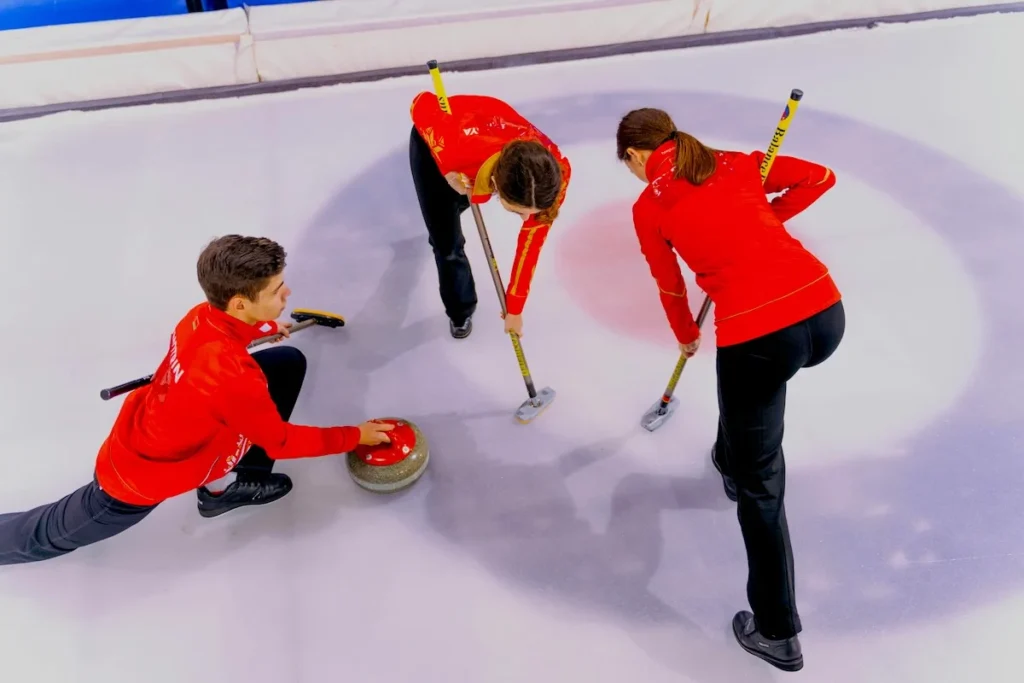
Using a brush or broom to clean the ice in front of a moving stone is one of the most characteristic aspects of curling. This custom has its roots in the time was played outside on frozen lakes, where the stone needed a smooth path made of cleared ice. Sweeping is still done on indoor rinks today because it smooths the surface and gets rid of loose ice particles, which makes it possible for the stone to go more precisely and farther.
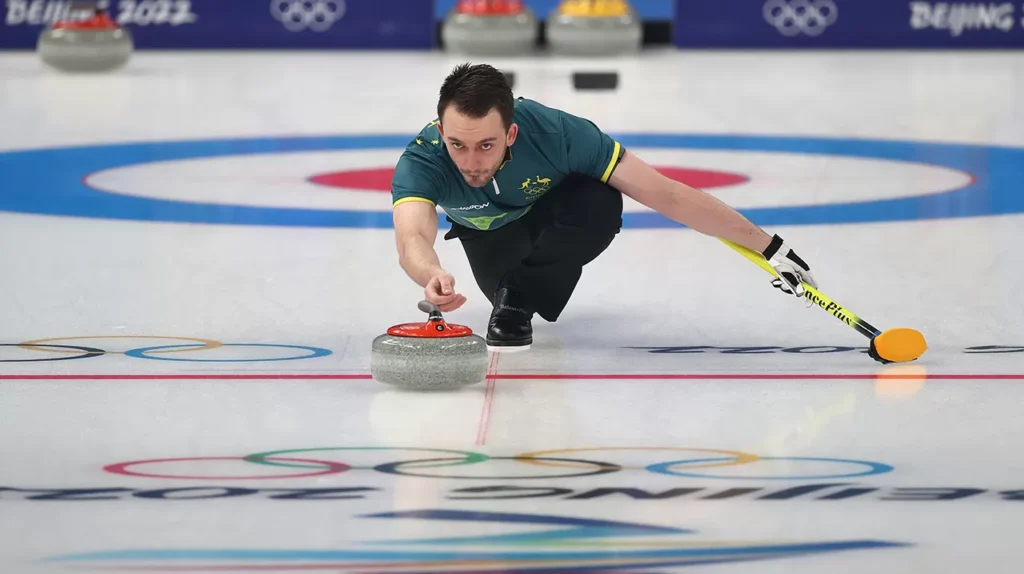
The skip employs the broom to mark the target, and players use it to stay balanced when delivering the stone. The ice surface is meticulously groomed. To aid guide the stones, a tiny mist of water is sprayed onto the ice prior to a match, giving it a pebbled appearance.
Since the early 16th century, curling has been played in Scotland, which is particularly linked to the sport. Curling was played in the Low Countries as well, according to paintings by Pieter Bruegel the Elder from the same era, but it was Scotland that contributed to the sport’s globalization.
With royal support, the Grand Caledonian Curling Club was established in Edinburgh in 1838 and changed its name to the Royal Caledonian Curling Club in 1843. Its function as an international governing body was its aim. There, in 1966, the International Curling Federation—now called World Curling—was founded.
Although the Royal Montreal Curling Club had been around since 1807, a Canadian chapter of the Royal Caledonian Curling Club was established in 1852. Since its inception in 1927, the Canadian Curling Championship has grown to become the world’s biggest curling competition.
The Grand National Curling Club of America, a branch of the Royal Caledonian, was founded in the United States in 1867. The Orchard Lake Club, located close to Detroit, Michigan, was established in 1832 and is the oldest curling club in the nation.
The United States Curling Association was established as a federation of 125 clubs in 1958 after the first U.S. Championship took place in Chicago in 1957. The United States Women’s Curling Association was established in 1947 as well.
There are Curling clubs or associations in the majority of Western European nations. Since 1959, World Championships have taken place, and Canadian teams have typically won these competitions. Although the International Olympic Committee did not formally recognize the event until 2006,
Curling was a part of the inaugural Winter Olympic Games, which were held in Chamonix, France, in 1924. Curling was included as a full medal event for the 1998 Games in Nagano, Japan, following its appearance as a demonstration sport in the Winter Olympics of 1932, 1988, and 1992.
At the 2006 Winter Games, wheelchair curling was added to the Paralympic program, in which athletes deliver the stone from a stationary wheelchair without the need of sweepers. Wheelchair mixed doubles curling will make its debut at the 2026 Paralympic Winter Games in Milan and Cortina.