
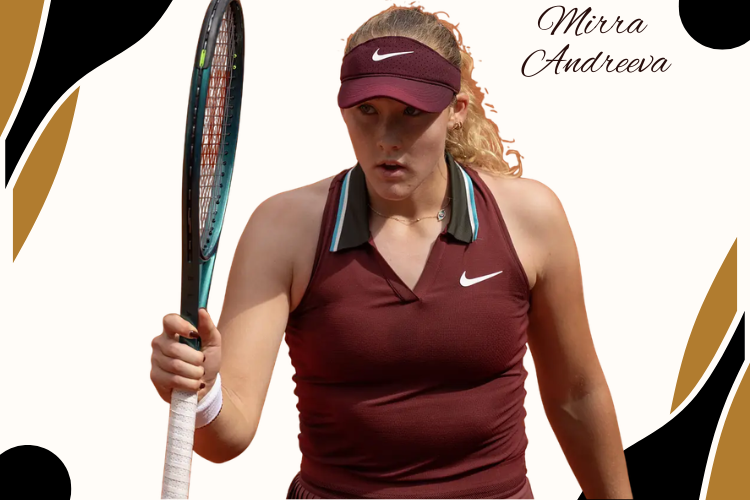
Mirra Andreeva’s Early Nerves in a Historic Grand Slam Final
It appeared as though Mirra Andreeva’s attention would begin to stray from Court Philippe-Chatrier just twenty minutes into her first Grand Slam final. The huge event, the weather, and a driven opponent who was ready to make her life difficult all appeared to be causing the 19-year-old a great deal of worry.
The Russian celebrity’s response to the pressure showed how hard she had worked to keep her emotions under control. After a nervous beginning,Mirra Andreeva’s Grand Slam Rise 7 Stunning Facts Behind. maintained her composure, skillfully overcame the difficulties, and gave an outstanding performance. She ended the Polish player’s incredible run by defeating qualifier Maja Chwalinska 6-3, 6-2.
A Rising Star Destined for Greatness:
It seemed obvious that Mirra Andreeva’s Grand Slam Rise 7 Stunning Facts Behind. would ultimately compete for major titles since she debuted on the circuit at the age of 15 and started defeating some of the best players in the world. How long it would take was the most important question.
Not very long, as it turns out. Since Monica Seles, who won the French Open three times in a row in 1992, Andreeva became the youngest champion. She is the third-youngest Grand Slam victor of the twenty-first century, behind Maria Sharapova and Emma Raducanu. Mirra Andreeva said, “I have imagined this moment for a long time,” in reflection of her triumph.
I gave a lot of attention to how, whether, when, and where it might occur. I can genuinely state that the experience in real life is significantly superior to what I had anticipated. It feels amazing to look at this trophy and know that I am a Grand Slam champion.
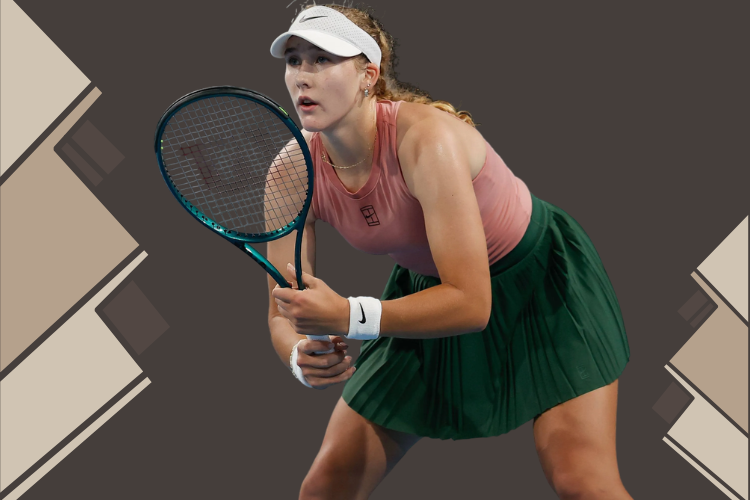
Celebrating a Dream Come True:
Mirra Andreeva’s Grand Slam Rise 7 Stunning Facts Behind. celebrated by collapsing to the ground after winning the championship with a spectacular backhand winner. She then went to the player box to give her family and team a hug. She praised her coach Conchita Martínez, who lost to Mary Pierce at Roland Garros in 2000 and was on stage to award the trophy, during her victory speech.
The young Russian also took the opportunity to express gratitude to Alexis Castori, her sports psychologist, for helping her adopt a more health-conscious style of tennis.
” Mirra Andreeva’s Grand Slam Rise 7 Stunning Facts Behind. revealed that her psychologist frequently reminds her that she is in charge of how she competes, how she behaves during games, and the kind of person she is. she wants to be both on and off the court.”I made the decision to become a fighter.”
Inspired by Roger Federer:
She also disclosed that one of her main sources of inspiration had been Roger Federer. On this court, I was able to watch a number of Roger’s matches. I wanted to emulate his demeanor on the court, even though I will never have the same aura as him—nobody will. I’ve always enjoyed seeing him play. Perhaps that helped me a little because I wanted to appear calm and upbeat on the court rather than angry or dissatisfied with my performance.
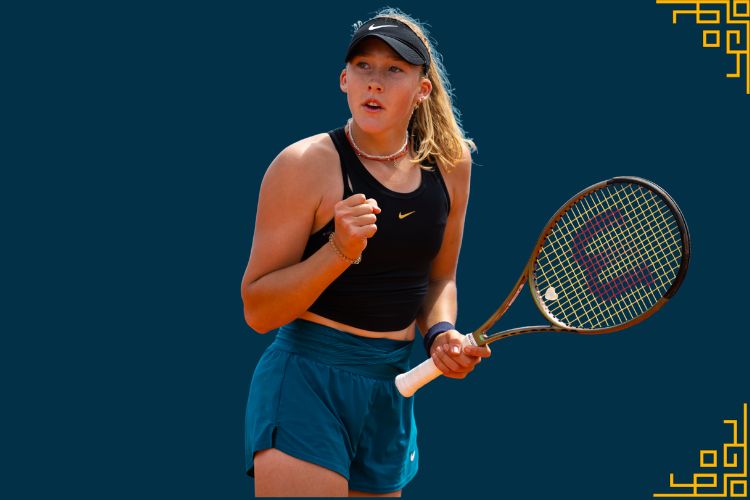
The Challenge of Facing Maja Chwalinska:
Even while most players would love to play the world No. 114 in a Grand Slam final, there were still risks involved. After Raducanu, Chwalinska became the second qualifier in history to advance to a Grand Slam final. Mirra Andreeva knew going into the match that she was the clear favorite. Even though it was her first big final, she would have been really disappointed if she hadn’t won.
From the start, it was clear that addressing Chwalinska would be mentally taxing. To agitate her younger opponent and throw off her rhythm, the Polish player employed every strategy imaginable. She combined low slices, drop shots, looping topspin strokes, crisp angles, and occasionally strong forehands from her left side. It was quite difficult to hit through her because of her exceptional defensive abilities.
Overcoming Adversity on the Court:
Mirra Andreeva’s Grand Slam Rise 7 Stunning Facts Behind.’s problems were exacerbated by the slow conditions and high winds, and some of her negative habits soon returned. She struggled to pace her forehand correctly and turned passive and reactive. Throughout the first five games, she employed high, slow “moonballs” a lot because she was afraid of making mistakes.
The ball appeared to travel at half speed on both sides of the net in contrast to the previous two Grand Slam finals, which included some of the century’s most explosive shot-makers, such as Aryna Sabalenka, Elena Rybakina, and Amanda Anisimova. Mirra Andreeva’s Grand Slam Rise 7 Stunning Facts Behind. recovered her composure after falling behind 2-3 after two double faults and an error-filled comeback game. For the first time in the match, she held her serve after starting to deliver excellent first serves.
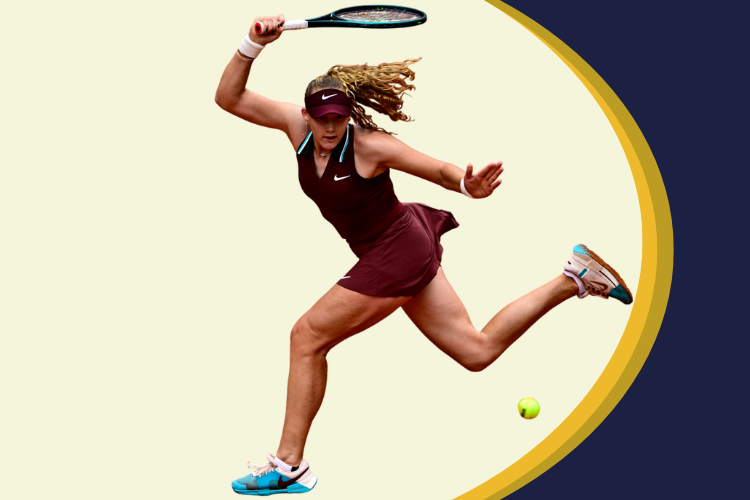
A Dominant Finish to Claim the Title:
She was able to step inside the baseline, take the ball earlier from both wings, direct it precisely, and manage the rallies because of her confidence. The 106-place ranking difference between the two players became more noticeable as she began controlling play. Mirra Andreeva’s Grand Slam Rise 7 Stunning Facts Behind. won nine straight games after falling behind 2-3 in the first set, and she easily finished the match to win the title.